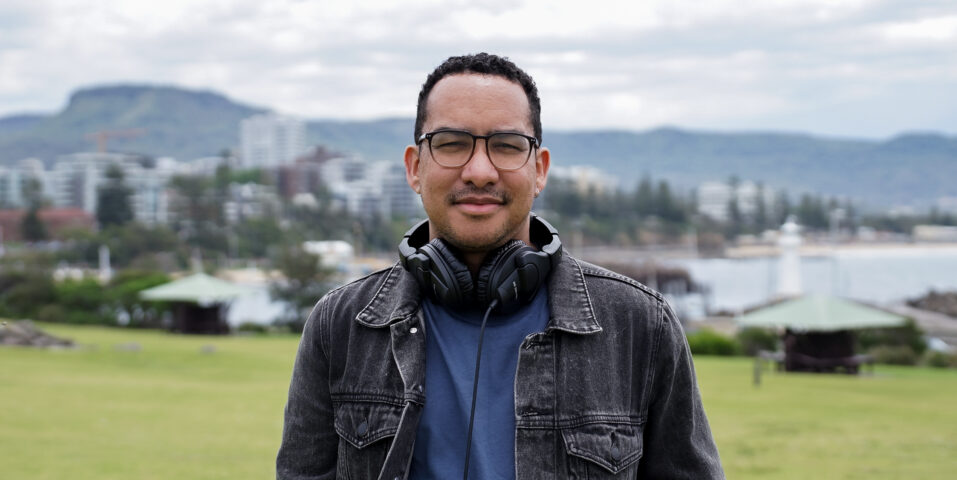
With a background in journalism, award-winning fiction writing and magazine editing, Kwame Slusher already knew how to connect with audiences through the written word. What drew him to audio was its ability to create a direct, personal connection with listeners. Supported by a scholarship while studying the Graduate Diploma in Radio and Podcasting (GDRP) at AFTRS, Kwame focused on developing his craft and building a career in storytelling.
Radio and podcasting start with writing, and Kwame immediately found transferable skills that would be useful, such as “the ability to structure a narrative in a clear and concise manner” and “explaining things in a way that even if a person’s not an expert in a particular area, they can understand what you’re talking about and take them along the journey of learning,” he said.
Originally from Barbados, Kwame moved to Australia in 2015. As magazine editor for the Australian Compliance Institute, he distilled complex information into clear concepts, and that work evolved to include podcasting as audiences changed how they consumed information. Through this work, audio entered his life and opened a world of possibilities.
Living in Wollongong for the past four years, Kwame decided to practise and learn more about audio, and started his journey at TAFE. He later committed to studying radio and podcasting at AFTRS after GDRP Convenor Natalie Pozdeev introduced the course to his class.
“At the end of TAFE, I was definitely ready to take it to the next level. To learn more about the industry and about content and structure; AFTRS is the school to learn that,” he said.
When he enrolled at AFTRS, Kwame applied for the CRA Regional Radio Scholarship, available to GDRP students living outside Australia’s major metropolitan centres. Awarded by Commercial Radio & Audio (CRA), the scholarship supports students with living and study expenses and includes a two-week industry internship. For Kwame, it provided the financial support and the freedom to focus on telling stories from the Wollongong community.
Having moved there just a couple of years before starting the GDRP, the scholarship was the perfect fit because Kwame still felt like he was learning to live in Wollongong.
“I discovered Wave FM, discovered Vox FM 98, and just really liked the way that they captured the stories of what was happening in Wollongong,” he said. “I really felt the scholarship would give me that space, from a financial position as well, to be able to tell those quirky regional city stories that you probably wouldn’t get in the metropolitan areas.”
The scholarship was pivotal for Kwame: “Receiving the scholarship has had a tremendous impact on me. “And so, getting that scholarship gave me that financial space and that breathing space. It’s [like], ‘I don’t have to have a million jobs’. I can focus some of my time on study.”
His two-week internship at Wave FM gave him the opportunity to learn how a commercial radio station runs. On air from day one, Kwame worked for the street team, for promotions, for the breakfast producer; he got to play with the G selector and do competition analysis, “everything, and it was a lot of fun”.
The time dedicated to the GDRP ran alongside other projects and work. With the option to attend classes flexibly, Kwame took advantage of the best of both worlds: attending some classes online and joining other students on campus for live exercises, productions and collaboration, with access to the studios.
“I did Show Radio, I did 2NRS, and I did AFTRS FM,” he said.
These live exercises bring everyone together to plan, program, write, produce and broadcast for real audiences, whether at the Sydney Royal Easter Show, regionally, or within the AFTRS community. Deadlines, collaboration, workflows and technical requirements deliver hands-on learning from as soon as three weeks after the course starts.
At AFTRS, he didn’t just become a better storyteller, he also “went beyond what he thought he could do” and went through a “paradigm expansion about what was possible thanks to the course.”
Looking back at the skills gained through the course, Kwame said he’d also had “a bit of a paradigm shift or a paradigm expansion” in terms of future possibilities.
“I thought, ‘Audio producer, that’s what I could be’. But once studying at AFTRS, I have come to realise that there are so many other audio-related roles in the space that you can do,” he said.
“I’m an independent podcast producer. I’m a production manager for a radio show. I do some audio production work. I do some recording work for an art gallery.
“I think I’m well on my way to actually going beyond what I thought I could do, and the possibilities are still unfolding for me.”
Today, Kwame is Production Manager for All The Best at FBi Radio, where he works with writers, producers and the presenter to bring original audio stories to life. The professional network he built through TAFE, AFTRS, CRA and the wider audio community is a key source of collaboration and opportunity.
“We basically come up with the idea for what the episode is going to look like when they’re going to play. And then I make sure that the audio is there, make sure the scripting is sorted. I sit in with the host and help them get it recorded, and then I mix the episode at the end or work with the designer.”
At FBi, he found a key centre for his creativity. “[The]FBI radio community is incredible,” said Kwame, who started at the station as a volunteer before studying the GDRP, and has integrated all of his learnings directly on the job.
“I’d be in class with [GDRP Discipline Lead] Andrea Ho from 9 to 5, and then I’d go to FBI in the evening and be, OK, I learned this today, this is what we need to do to make the show industry level.”
Kwame is interested in stories that bring to light the richness of being human and sharing life in the magic and beauty of the world through a medium that “it’s very personal, it’s speaking to you, the listener, directly. It’s just a voice in your ear guiding you along space.”
“For that period of time, they’re listening, and it’s just the idea of audience connection. I think that’s really impactful.”
