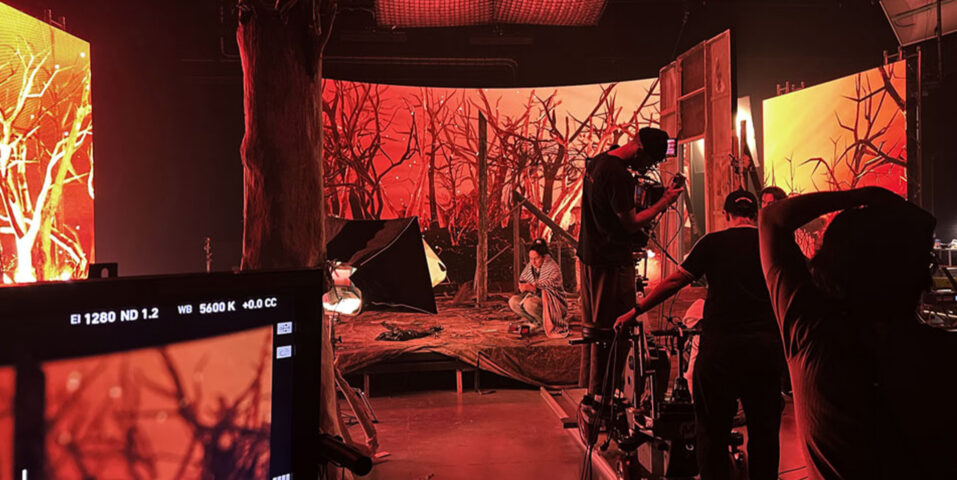
“Imaginary worlds have always been sites in which we can prototype ideas about who we might be, who we could be in the future.” – Liam Young
How are emerging technologies changing not just the way stories are told, but what they can do? As audiences move between film, audio, games and immersive experiences, storytellers are increasingly being asked to do more than create compelling narratives. They’re creating worlds that audiences can explore, participate in and even use as a space to reimagine the future.
At this year’s Digital Futures Summit, AFTRS called upon industry leaders Naphtali Faulkner (Origame Digital), Katarina Cizek (Co-Creation Studio at MIT Open Documentary Lab) and director Liam Young to discuss how worldbuilding, collective storytelling and emerging technologies shape the way stories are being told and how futures are being imagined – and made.
The conversation was framed by the summit’s theme, Regenerate: To Restore, To Renew, To Reimagine.
Moderated by AFTRS Production Design Discipline Lead Natalie Beak, the session established the concept of worldbuilding and its close relative, worlding, and why the way we tell stories is evolving.
“Worldbuilding [is] the intentional craft of constructing a world from which story emerges, and worlding [is] the more expansive practice of treating world making itself as an ongoing collective and participatory act,” Natalie said.
“We have deeply embedded assumptions about how stories need to be told, made and experienced. Assumptions that, in the Western tradition, trace back to an Aristotelian idea of story, of character and society… hardened into industrial practices through mechanisms such as the printing press, the cinematic frame, and now we wrestle with algorithms.
“We’re living through a period of extraordinary technological and environmental disruption, so the question this session is really asking is: Is this the moment that those assumptions finally change?”
As the panel explained, worldbuilding and worlding can create experiences that extend beyond simply setting the scene, encouraging audiences to engage with complex systems, perspectives and future possibilities.
In his video game Umurangi Generation, Naphtali explores how worldbuilding creates conditions for stories to emerge. His main character is navigating a world on the edge of collapse, and players experience the social, political and cultural systems in the game through their participation.
“When we talk about worldbuilding, the idea is that we’re putting ourselves in a place that doesn’t exist,” Naphtali said. “[With games] there’s this element of craftsmanship where you have to consider every inch of the environment.”
“It’s not really about what we make, it’s about what our art can bring back out into the real world.”
Naphtali introduced the idea of ‘respectful design’, an Indigenous design methodology which reinforces the idea of audience participation, allowing individuals to move through a game, experience it differently and draw their own conclusions.
“In order for these people to get the full picture, they have to talk to one another. They have to actually form community around the thing they’re trying to talk about,” he said. “Games are this one [art form] where to actually experience the intended point of the artist, you have to participate in a world they have created.”
Katarina’s work at Co-Creation Studio centres around worlding, and champions the idea of collective creation and authorship. Her work supports teams that consist of storytellers and “placemakers” – such as architects, climate planners and urban designers – who use game engines and creative technologies to create virtual worlds. With a strong emphasis on community collaboration, this practice of worlding can help communities imagine possible futures and bring it into practice in real life.
“It’s this constant flow between real communities at the front lines, but also moving through virtual space, to tell and retell and reimagine futures,” Katarina said.
“It really is collective action, collective authorship, that gives us the best chances for not just survival, but the ability to thrive and renew … communing around the central practice and vision that we all have to work in a very interdisciplinary way to deal with this time of polycrisis.”

For both Katarina and Naphtali, story worlds have the power to help people understand complex systems and communities collectively address and reimagine the challenges they face.
For Liam, whose work blends science, technology and creativity, worldbuilding offers a way to explore solutions to real-world challenges, like climate change.
In his film Planet City, Liam collaborated with scientists, economists, political theorists and technologists to visualise a compact city created for Earth’s population to return the entire planet to nature.
“It’s a really intense collaborative process with all these different disciplines in order to imagine this city, but really what we’re doing is prototyping how we might live differently and asking audiences to explore that question,” he said.
For Liam, this kind of speculative practice gives audiences a way to explore ideas in a safe creative space before they become real-world decisions.
“One of the really important roles of worlding as a practice is to test those ideas before we enact them,” he said.
“We’re really prototyping how we might live differently. The futures we imagine really do become the futures that we end up living in.”
Watch the Worldbuilding: Restoring collective storytelling, imagining better futures session from Digital Futures Summit 2026 here.
