From the earliest days of cinema, music has helped audiences connect with stories on screen. Long before films could carry recorded sound, musicians performed live alongside moving images, giving emotion, shape and meaning to what audiences were seeing.
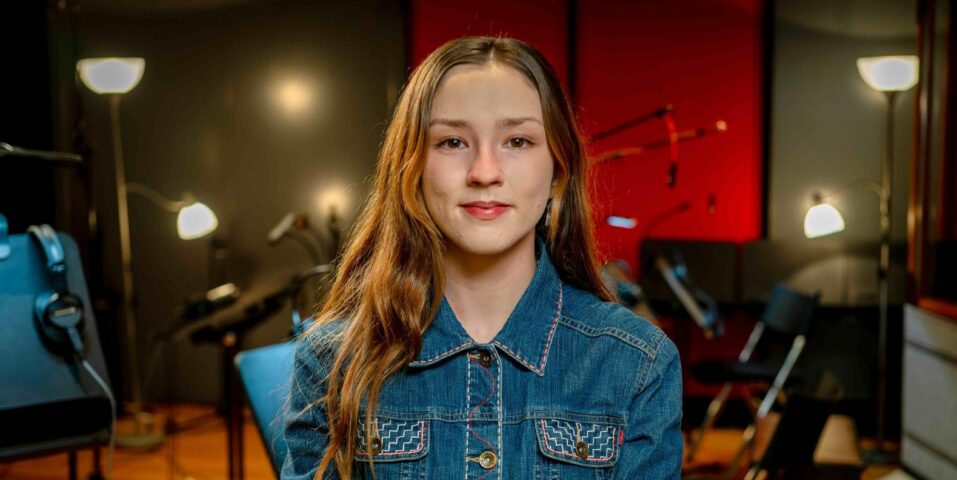
For composer and AFTRS Master of Arts Screen: Music student Darcy Archer, that relationship between sound and story has defined her creative journey. We talked with her to find out more about her journey into screen composition and the experiences that are shaping her practice.
From the age of nine, Darcy sang in choirs and studied classical percussion at the Central Coast Conservatorium, and during high school she began composing her own pieces inspired by the creative process surrounding her. Witnessing firsthand how music can encapsulate characters and worlds, Darcy recalls observing AFTRS alum Caitlin Yeo scoring The Long Goodbye documentary, directed by Kaye Harrison (Darcy’s mother and AFTRS alum).
“I remember Caitlin composed this particular sequence of music for the opening scene of the film that introduces each of the characters, and what she created just encapsulated each of the characters’ souls so beautifully,” Darcy said.
“[She] captured something so intangible – the feeling of a person, their energy, just through sound; sound that was responsive, sound that listened so intently to the story, sound with such respect for the image.
“I felt like I’d found a space that could harness both my sensitivity to emotion, to people’s stories, as well as my love of music.”
From that moment, there was no doubt in Darcy’s mind that this was the space for her to inhabit, to express herself, and to collaborate creatively.
Darcy was 16 when she composed for her first short film, and she continued this practice during her undergraduate degree at the Newcastle Conservatorium, which included time spent in northern Sweden, where she was granted the opportunity to study half of her degree at the Piteå Musikhögskolan in 2020. It was the first time she had the opportunity to have one of her film scores performed by the Sinfonia 941 Orchestra and to workshop her first choral piece, Annabel Lee, with a choir (Swedish Radio Choir Radiokören). The piece was later performed by The Australian Voices during their Elegy tour.
During her time in Sweden, Darcy also had the opportunity to score two short films: Music Central (dir. Kaye Harrison) which has been broadcast on ABC Compass and Mothertongue (dir. Glenn Fraser), which further tuned her path into the craft.
“Those experiences allowed me to move beyond simply aspiring to be a composer and begin identifying as one, so I decided to take a chance on myself and apply for the Master of Arts Screen: Music,” Darcy said.
“When I applied for AFTRS, I was living north of the Arctic Circle in a very remote Swedish town called Pajala. One of the application tasks involved composing a score for a short film. With no instruments, no DAW and no sample libraries available to me, I travelled several hours through the snow to the Piteå Musikhögskolan and wrote the score in a single afternoon. The experience forced me to trust my instincts completely. It is one of my favourite film scores that I have composed to date.”
Darcy’s musical composition developed between the world of formal education at two conservatoriums and exploration in contemporary, folk, and experimental music spaces – all informing her screen work. Whether through arranging for instruments and voices influenced by the experimental music she creates with her band Zeal H, or years of playing taiko drums and exploring rhythm traditions from different cultures, her practice shapes her approach to melody, rhythm and movement.
“For a long time, I viewed these musical worlds as existing separately from my screen work, but my time at AFTRS helped me recognise that my experiences across folk, experimental and choral music are not peripheral to my screen practice, but central to it,” she said.
“That is one of the reasons I found AFTRS so valuable. There is a major focus on finding your own unique creative voice.”
This experience is not unique to Darcy: “My cohort of composers all came from incredibly varied musical backgrounds, and those differences became a strength for each of us rather than a limitation.”
Darcy said the School provided access to resources and facilities that create a supportive environment for students to push themselves creatively.
“AFTRS offers an extraordinary creative environment for an emerging composer: dedicated composing suites, recording studios, a professional mix theatre, and the opportunity to hear your music brought to life by exceptional musicians,” Darcy said. “For many composers, access to those kinds of resources would otherwise be out of reach. Equally valuable were the teachers, Cameron [Patrick] and Greg [Wise], each of whom brought a wealth of industry knowledge and experience. Their guidance challenged my assumptions, expanded my understanding of the craft, and continually pushed me to become a more resilient but also more thoughtful composer.”
VISUAL POEM – AN EXPERIENCE LIKE NO OTHER
AFTRS’ pedagogic approach has a strong focus on practice and cross-disciplinary collaboration. During the program, composers have multiple opportunities to score films, perform live recordings, and work directly with a wider crew; it all comes together in the Visual Poem, a live recording with a small chamber orchestra.
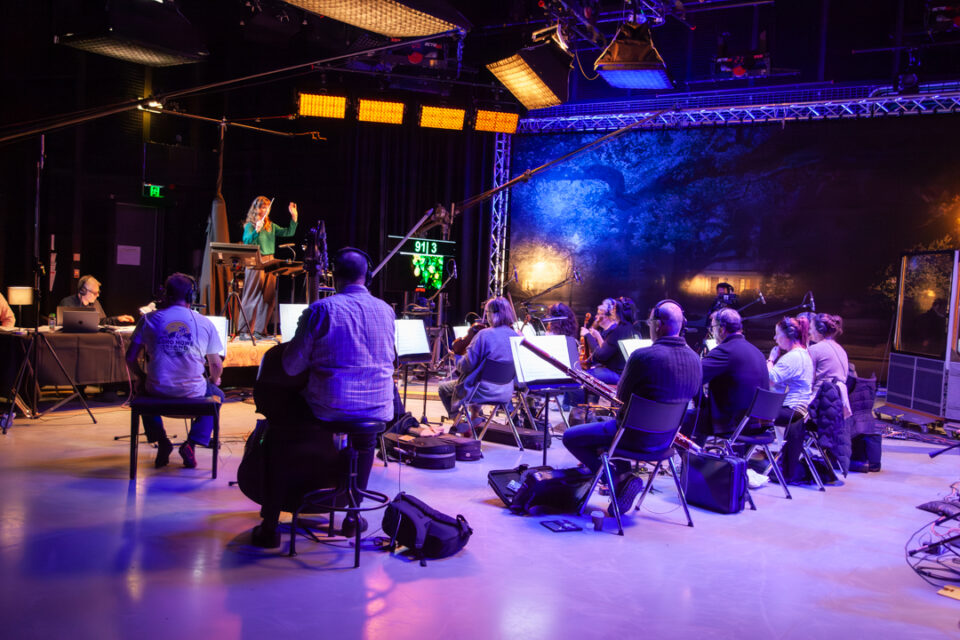
AFTRS Discipline Lead (Music) Cameron Patrick explains this exercise is the culmination of months of learning, and it “offers the students the opportunity to experiment with carefully composed imagery, editing and music to create meaning and emotional resonance up on the screen.”
The creative process is initiated by structural ideas that develop through a dialogue with composer, cinematographers and editors – a probe into each discipline’s language and tools.
“For the three disciplines involved (Music, Cinematography and Editing), it is a rare opportunity to collaborate as equals, with each member of the team having the creative freedom to respond to the work of their peers and express themselves outside of the constraints of narrative drama or a directorial brief,” said Cameron.
Providing industry-informed practice and access is an important step in developing craft skills in an educational setting, contributing to the holistic growth of the students and emerging practitioners, he said.
“I don’t see any equivalent way of gaining experience fine-tuning the real-time communication skills required to lead professional musicians short of putting our students up on the podium in front of them in the recording studio. Real musicians can instantly adjust their articulation, phrasing, or mood based on feedback, and there is no question that a real ensemble amplifies the emotional impact of a score and brings a composer’s music to life in ways that are fairly impossible to replicate with instrumental samples.”
The Visual Poem experience informs communication with musicians and other crew members, but it also offers insights into music composition itself and the spectrum of possibilities within a score, said Cameron: “I feel this project, almost more than any other, affords the students a chance to put their authentic creative on display and showcase the art of orchestral composition as well as the craft of screen scoring.”
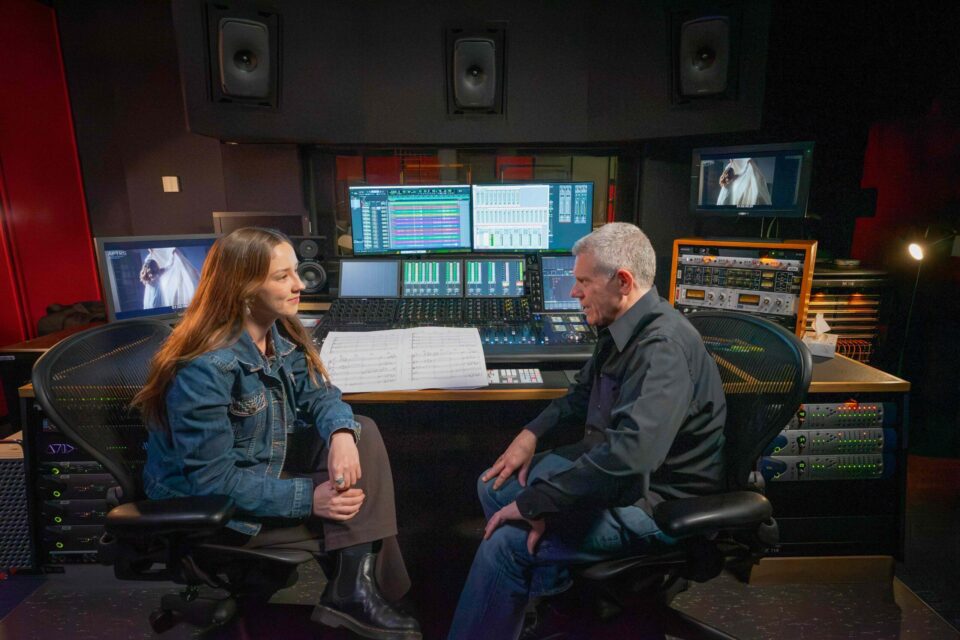
Darcy notes the pressure associated with composing a film score for orchestra and leading a recording session from the podium, but said she felt prepared.
“Over the course of the two-year degree, composers have the opportunity to compose for and conduct multiple smaller recording sessions with strings, brass, percussion, harp and woodwinds, so by the time the Visual Poem arrives, you are more than prepared to step up to that podium with confidence,” said Darcy.
“The Visual Poem is, in many ways, the defining moment of the Master of Arts Screen: Music. It brings together everything the course teaches about collaboration, responding to picture, writing for different ensembles, and leading musicians through the recording of a score.”
Last year Darcy worked with cinematographer Ali Rezvani and editor Zac Loy on the Visual Poem, From the Earth or the Skies, which reinforced in her creative process for screen composition the importance of working to image, allowing the material that defines the story to influence and speak to the composition directly.
“What I found most rewarding about the Visual Poem project was that, although I was given significant autonomy as a composer, the film itself provided a profound sense of direction,” she said. “It reinforced something I value deeply about screen composition: that the most meaningful creative decisions often emerge not from imposing an idea onto a film, but from listening carefully to what the film is already trying to say, a sort of ‘grassroots’ approach to composition.”
Darcy’s From the Earth or the Skies Visual Poem recording, including the other Visual Poems by her cohort Alexandra Farr, Gabriel Wright, and Luke Horsley, can be watched here.
This year’s Visual Poem will take place on Friday 7 August, with students conducting their scores in a live recording session. The event will be livestreamed from 1pm to 5pm here, and will showcase the work of 12 students from the three different disciplines across four Visual Poems.
SCORES OF WORK, INCLUDING SONG
During her time at AFTRS Darcy has composed scores for AFTRS productions Empress (directed by Lucien Jones), and Flowers for Hamish (directed by Laura Turner). Empress is a short documentary centred on Sydney drag performer Dyan Tai. The film screened at the 2025 Mardi Gras Film Festival and is part of the AFTRS First Cut program that streamed on Docplay in 2025. Flowers for Hamish has premiered at St Kilda Film Festival this year. Through practice and creation across different projects and collaborations, Darcy started identifying the creative throughline running through her work.
“One aspect of my process that has remained consistent over the years is that I sing my melodic ideas before I play them. I often find that melodies reveal themselves most naturally through the voice,” said Darcy.
“During my time at AFTRS, I began to place greater focus on the voice as an instrument and to explore its unique ability to capture and transmit complex emotional states. I wrote a score containing multiple vocal parts for Threshold (directed by Ash Gray), and that exploration continued when Laura Turner approached me to compose the score for her capstone film, The Performance. Laura already had a strong vision for the role of the voice within the score and, by the end of the process, every cue in the film except one consisted entirely of vocals.”
For The Performance, Darcy worked with vocalists Mia Peters, Byren Sawell and Ruby Archer to bring their unique voices to a textured musical score featuring intakes of breath, sighs, and lyric-less vocals singing a combination of vowels and consonants.
“It was great to get to work so closely with Mia, Ruby and Byren on this score, and I feel exceptionally proud of what we were able to create together,” said Darcy.
With an extensive range of musical options in her compositions, the uniqueness of the human voice has become central for Darcy’s creative expression: “The human voice is a wondrous instrument and one of my favourite instruments to compose for. There is something incredibly special about its timbre that connects people to one another, to emotion and to story.”
