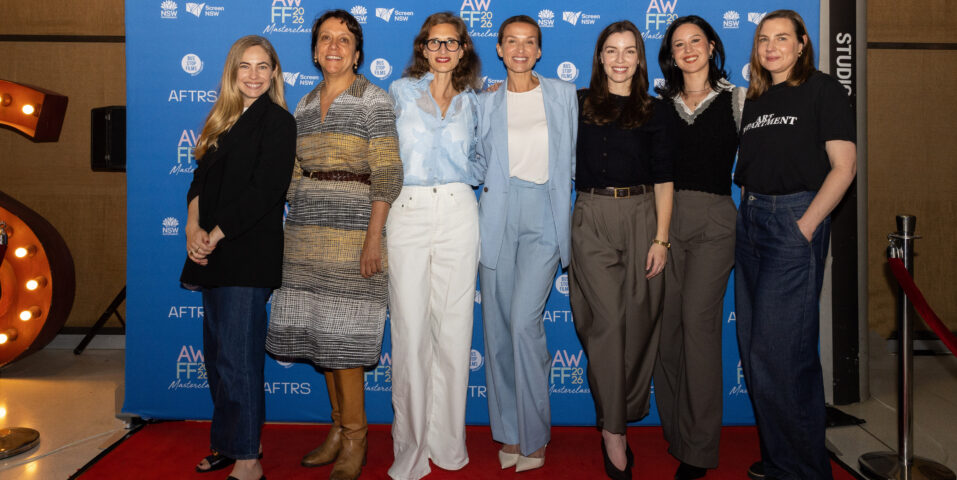
Australian Women’s Film Festival (AWFF) presented its inaugural masterclass, Inclusive by Design, with Bus Stop Films and the Australian Film Television and Radio School (AFTRS) on Thursday 24 September at AFTRS.
The event brought together Tahyna Tozzi (AWFF co-founder and moderator), Rachel Perkins (AFTRS Council Chair and Director of First Nations Strategy, Screen Australia), Natalie Beak (AFTRS Discipline Lead in Production Design), AFTRS alum Lianne Mackessy (screen industry leader) and Dianna La Grassa (Chief Operating Officer and Resident Producer, Bus Stop Films) to explore inclusion as a creative force rather than a compliance exercise. The conversation focused on gender representation, disability-led filmmaking, First Nations storytelling, and what Australian cinema looks like when everyone has a seat at the table they helped build.
The panel shared their views on what it means to approach production with an inclusive mindset: being inclusive by design. Treating inclusion as a creative principle starts in the writing process, bringing on board a range of voices, world views and perspectives, reflecting on how these are represented on screen, during the creative process and on set, informing storytelling throughout the filmmaking process, the panel observed.
INCLUSIVE LEADERSHIP
This inclusive approach needs leadership support, said Rachel, adding that diversity is embedded within the Australian screen production guidelines, representing a significant milestone achieved through the sustained efforts of leaders from a range of underrepresented communities.
“Leadership creatively, but also leadership at the policy, political, and organisational level and in government is really important. And those are things that have been hard fought for and won,” said Rachel.
This is what contributes to ongoing progress – representing audiences who may not have seen themselves on screen and telling stories that might otherwise go untold: “Hopefully it’s changed the country. Our challenge has been to get people to walk in the shoes of the people of our stories. That’s the great thing about film and television, that it can allow people to see different perspectives. And that’s why we do what we do.”
Rachel noted the importance of having creatives in key roles on productions with lived life experience in relation to the story, and how she chooses to work with colleagues that create a culturally shared space.
“All of the productions I’m on, it’s been my company, I’ve been the director, the producer, when people walk on set, they know that basically black fellas are running the show, and that gives us a real sense of empowerment. We do things our way, there’s a certain cultural approach that is embraced, and we’re very proud of that,” said Rachel.
STORY INFORMED BY REAL EXPERIENCE
Nina also spoke about the importance of involving people with lived experience from the beginning, for stories to reflect genuine experiences rather than assumptions. She recalled the creation process for an SBS show she collaborated on with “Angus and Emma”, who both have cerebral palsy:
“I felt like they were telling me their stories and I was adding the structure to them. But I think that what came out was a very truthful representation of their lives and their experiences dramatised for TV.”
Dianna agreed: “I think some of the best ideas come when you have a lot of diversity in the room, whether that is gender, cultural, and disability representation,” she said. “And I think stories get better, but I also think they get more interesting because they’re told from a different lens and a different perspective.”
By incorporating this inclusive framework from the outset, it flows through every production and creative decision, bringing a level of authenticity that makes stories more engaging, she said.
As part of her Master of Arts Screen studies, Lianne directed Tuesday Tuesday, a story about the relationship between a carer and a family dealing with early-onset dementia. Although she chose to tell the story from the carer’s perspective, as it was one she understood from her own lived experience, she also pursued a deep understanding of the other characters so they could be represented fairly.
“You still need to make sure that they’re not just an object in somebody else’s story. Do they have agency? Do they have specificity, or are they there purely just for the protagonist’s change? So that’s a question that I would always ask myself,” said Lianne.
FROM INCLUSIVE STORY TO INCLUSIVE PRODUCTION
Talking about Bus Stop Films’ feature Boss Cat, Dianna shared how bringing inclusion from the beginning and onto all processes gives the story “new life, you’re giving it a new perspective, and that’s what people want. That’s what audiences want. So be inclusive from the beginning.”
Boss Cat will be released in December following selections at various film festivals, including Sydney Film Festival and Melbourne International Film Festival. The production employed more than 10 people with disabilities across 21 days of filming in key crew departments, including camera, production, hair and makeup, sound, lighting, directing and editing, as well as many on-screen roles. The film was produced in association with Screen NSW and WeirAnderson Films and received production investment from Screen Australia.
“We had to be really build into what we were thinking about, not just in terms of the location, but also in how everyone on that set could belong at every stage of the production,” said Dianna.
Inclusive practices and principles shape both functional and creative decisions, informing world-building through the needs of characters, cast and crew. Natalie worked on Boss Cat and helped bring this framework to life through intricate communication, attention to detail, and a deep understanding of lived experience and sensory needs that informed the film’s production design.
“Generally, my art departments are pretty neurodiverse,” she said “I think we had a 100% hit rate on Boss Cat, which we’re very proud of – incredibly creative, incredibly visual people with something really important to say.”
“I really try and embed that within my crews and actually having those conversations with my crew members. What is it that you need? How can we support you?”
According to Nina, having crew with life experience allows for questions to be asked about the perspective on the story. Knowing who is being represented and who is the audience enables crew to ask the right questions at the right time so an inclusive mindset can bring a deeper understanding of the story being brought to screen.
“Who is your audience? Who are you making your art for? And I think, for me, I think you should make your art for yourself. You should make the things that you want to watch, that you find interesting,” said Nina.
“If you’re a producer, a director, and you have the privilege of staffing, you need to have the set that you want to have, and put the people in place that are going to know your vision, but also foster the kind of environment that you will thrive in and others will thrive in.”
Dianna added that inclusion improves working conditions for everyone. Whether it is accommodating the needs of working parents, considering different cultural perspectives, or creating sets that are sensorily accessible, opening the door to inclusion creates a more flexible and sustainable workplace and creative environment. It also shows up in the stories themselves.
“I want to see real integration, real intersectionality, because we are all such complicated human beings. Ask, ‘Who’s on your set? Who are you representing? You know, if you are a female, are you the only female?’ Have more, have more,” said Dianna.
