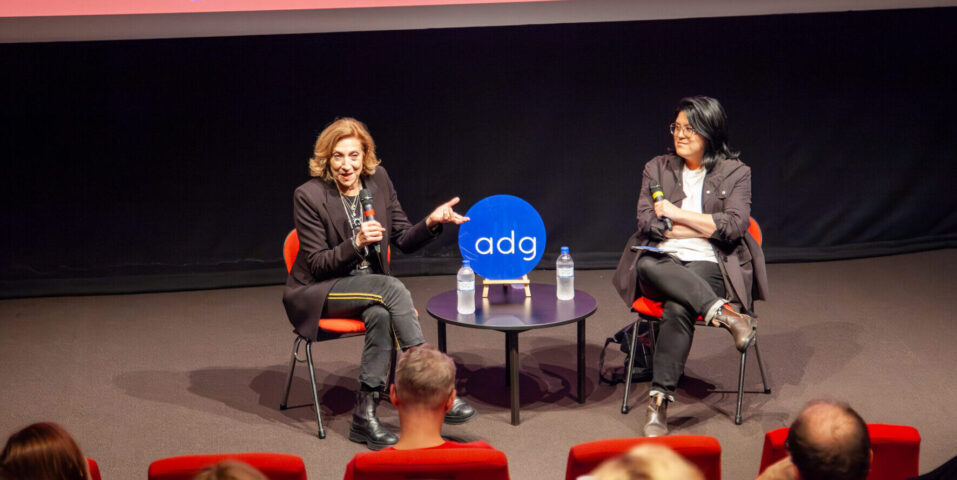
Starting her screen career under Steven Spielberg’s wing for the Amazing Stories series (1985) and exploring her directorial voice alongside David Lynch on Twin Peaks (1990), Lesli Linka Glatter has built a decades-long formidable career spanning television and film. Her credits include Homeland, Mad Men, The Morning Show, and Zero Day.
As President of the Directors Guild of America, Lesli brought her signature energy to AFTRS for the latest Australian Directors’ Guild (ADG) Deep Dive, presented in collaboration with Screen NSW. The conversation was hosted by acclaimed Taiwanese-Australian director Corrie Chen, whose own work in series like New Gold Mountain and Bad Behaviour has made her one of Australia’s most exciting directing voices.
Not one to shy away in the face of challenge, Lesli’s passion and profound understanding of the director’s craft and her focus on the importance of point of view and character motivation grounded the insights into the ever-changing role of the director.
Together, Lesli and Corrie delivered a rich, intimate discussion on the art of directing. AFTRS Master of Arts Screen students Sasha Parlett and Lily Boisvert attended the session and shared their reflections.
There is not one “right way” to direct
For Sasha one of the messages that left a longer impression was that of taking time to develop your craft and creative relationships that will be fundamental in shaping a directorial voice and projects:
“As a director it is important to have a clear understanding of each department and how they operate. Having great collaborators is key to success in any project,” Sasha said.
This is something that has echoed with Lily, who said: “As someone pursuing a creative career, I often question the best path to my goals or how to become a better filmmaker. Lesli’s advice eased those doubts, reminding me that being at AFTRS is about discovering my own philosophy as a filmmaker and building a personal directing toolkit.
“[Lesli] spoke deeply about the impact of her mentors, some of the most renowned filmmakers in the world, each with their own approach and storytelling style. She also emphasised the importance of clarity of intent and knowing the story you want to tell, as ‘story will save you’ from most challenges in the collaborative filmmaking process.”
Head + Heart + Gut
The discovery of oneself is fundamental in becoming a great director, Lily explained, referencing the “head + heart + gut” idea that came from Corrie Chen.
“She described directing as a constant battle between your head, heart, and gut,” Lily said. “I interpreted this as the balance between preparation and craft (head), personal story and values (heart), and intuition and openness (gut). Together, they form a beautifully simple way of summing up the directing process.”
Lily also noted how, as a director, this could impact those around you: “When Lesli asked Corrie what directing meant to her, she replied that ‘a director creates atmosphere’, empowering each team member to do their best and contribute to the story.”
Sasha also picked up on this, taking away this message: “Have a good relationship with your actors and don’t push them beyond their limits. If you create the vibe off-set then it won’t feel like acting on the screen.”
You can tell multiple stories
“Throughout her career, Lesli has directed an extraordinary range of genres, formats, and styles, from Now and Then, Amazing Stories, and Twin Peaks to ER, The West Wing, Gilmore Girls, and Mad Men. She made it clear that as a director, you don’t need to tie yourself to one genre, style, or format,” Lily noted.
“If a project ‘grabs your heart and grabs your gut’, then it’s the right one for you. She also noted that who you are, your experiences, your footprint on the earth, shapes the stories that draw you in, and those interests will evolve over time. Above all, your career doesn’t need to be narrow; you can reach across a wide spectrum of stories.”
This visceral response to materials is a strong indicator of interests and syncronicities, Lily said, adding that trusting this sense is key because “it is important to tell stories that resonate with you”.
“If the story doesn’t grab you in the gut, then you are not the person to tell it. Even as a young director if you can find stories that relate to you it is important for your career,” she said.
Be open to the possibility of life
Lily said that “of all the anecdotes and insights shared between Lesli and Corrie, Lesli’s attitude of “being open to the possibility of life” is the one that stayed with her the most.
“[Lesli] explained that you can do all the planning in the world to direct a scene or moment, but you should never forget the beauty of spontaneity and the uniqueness each collaborator brings,” Lily said.
“She recalled a moment with her early mentor, the late David Lynch, who made a spontaneous choice in Twin Peaks: instead of hanging a stuffed moose head on the wall as scripted, he left it on the table between two actors. Lesli looked out at us in the audience and said, ‘Don’t miss the moose head sitting on the table’, meaning don’t default to the ordinary. Life is strange, people are fascinating, and your films should reflect that.”

The Master of Arts Screen program at AFTRS is designed to create the space for deep creative inquiry that is fundamental to discovering one’s voice. Delivered in nine disciplines – Directing, Producing, Screenwriting, Cinematography, Editing, Production Design, Sound Design, Music, and Documentary – the program encourages students to explore their craft and practice through collaboration and mentorship.
Events like the ADG Deep Dive offer students’ direct access to industry leaders and real-world insights. Recently, AFTRS has also welcomed Palme d’Or winner Apichatpong Weerasethakul, who shared his philosophical and creative considerations behind films like Memoria (2021), Vapour (2015), and Uncle Boonmee Who Can Recall His Past Lives (2010). This event was presented in partnership with the Museum of Contemporary Art Australia, and Apichatpong is among a rich list of guest speakers who provide AFTRS students with firsthand insight into the screen and audio industries, as well as the fundamental work required to develop one’s craft.
